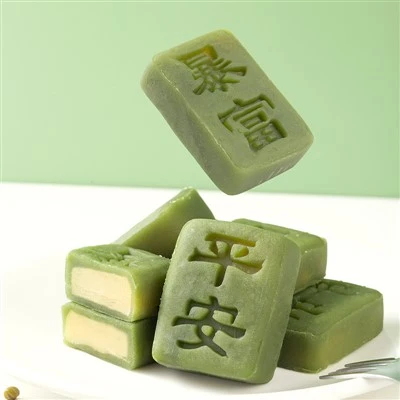
The essence of Yunnanese flatbread often lies in the unassuming stalls lining the streets and alleys. Tengchong boasts the crispy cakes along the Dieshui River, Dali has the Xizhou crispy rice cakes, and in central Yunnan, jujube paste cakes are a common and fragrant dish in many kitchens. Unassuming and simple in ingredients, it always provides a satisfying feeling at the breakfast table or during afternoon tea. Making jujube paste cakes isn't difficult; the key lies in the preparation of the jujube paste and the consistency of the dough. Yunnanese people strive for a natural jujube aroma, a chewy crust, and just the right amount of sweetness-not cloying, but rather a subtle sweetness that melts slowly in the mouth.
Select plump red dates, wash them, and soak them in warm water for half an hour until the skin softens and the flesh absorbs enough water. Then, pour the dates and water into a pot and simmer over low heat for twenty minutes. Cook the dates until the pits can be easily removed by hand. Remove them from the water and let them cool slightly. Remove the pits, and blend the date flesh, along with a little of the cooking liquid, into a puree using a food processor. If you don't have a food processor, you can use a spoon to repeatedly mash and sieve the mixture, but it will take more time. Pour the puree into a non-stick pan and cook over low heat, stirring constantly, to evaporate excess moisture. When the puree becomes thick and can be formed into a ball, turn off the heat and let it cool. This step is crucial; if the moisture isn't absorbed sufficiently, the filling will easily break.
Next, prepare the dough. Regular flour is fine; there's no need to be too particular. Add a small spoonful of lard to the flour, then slowly pour in warm water, stirring with chopsticks as you pour until it forms clumps. Then knead by hand into a smooth dough. The dough should be slightly softer than dumpling dough but firmer than leavened dough. Cover with a damp cloth and let it rest for 20 minutes. Divide the rested dough into evenly sized portions and roll each into a round wrapper that is thicker in the center and thinner at the edges. Take a portion of cooled jujube paste, roll it into a ball, place it in the center of a dough sheet, pinch the edges closed like a bun, and then gently flatten it into a pancake shape. Brush a thin layer of oil in a pan, place the prepared pancake in, and cook slowly over low heat. Don't rush the cooking process; cook one side until golden brown and set before flipping to the other side. Repeat this flipping process twice. The pancake is done when it puffs up, both sides are a beautiful golden brown, and the aroma of jujubes wafts out with the steam.
Freshly cooked jujube pancakes are the best. The outer layer is slightly crispy, and the jujube paste filling is smooth, sweet, and not too cloying. In Yunnan, people often eat this pancake with a bowl of Pu'er tea or a glass of plain water-simple yet comforting. Letting it cool slightly softens the crust, offering a different texture. If you make a large batch, you can freeze it and reheat it when you want to eat it; the taste will be almost identical to freshly made.